

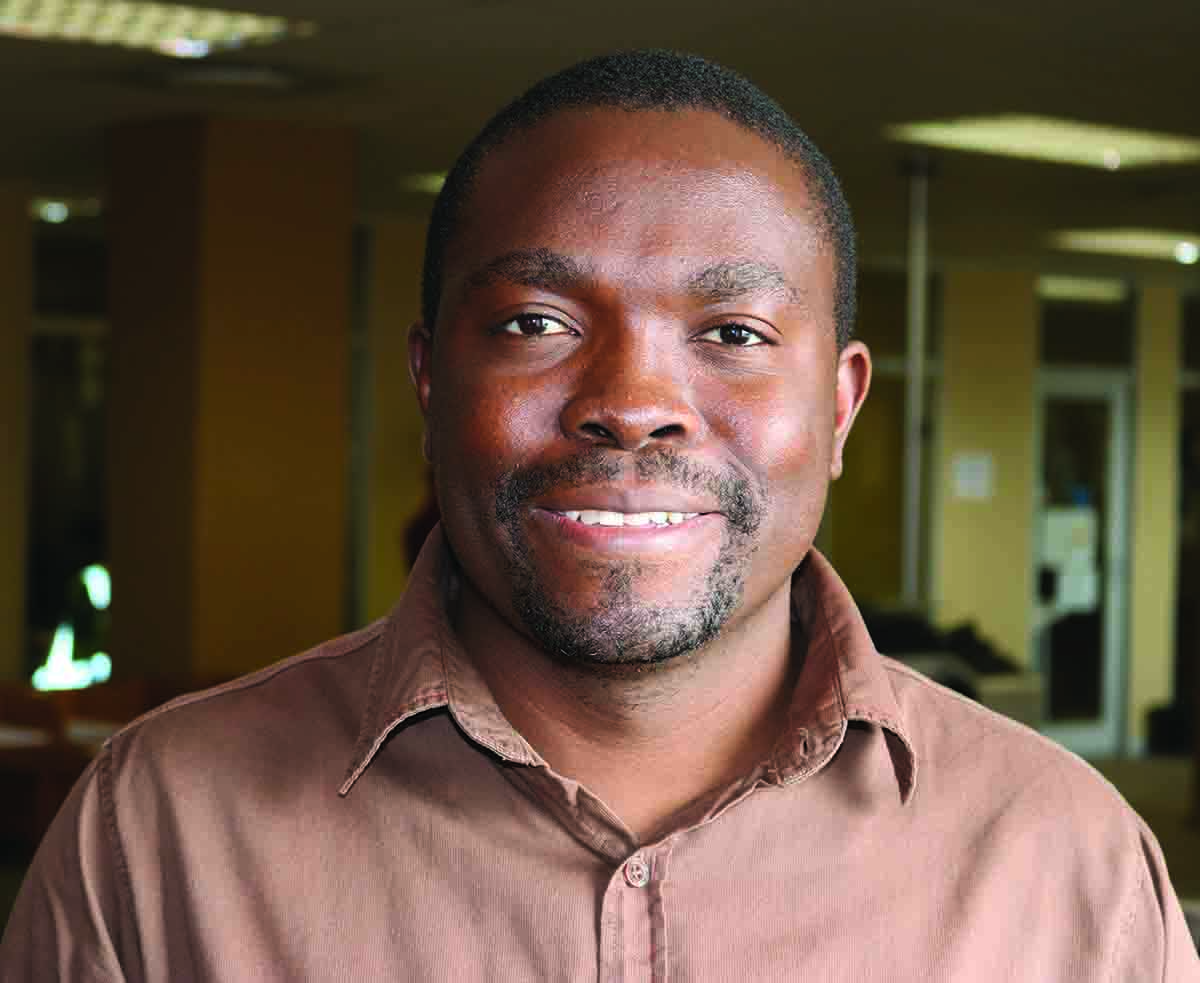
Production scientist, Fannie Shabangu, uses acoustic technology to understand and monitor the smallest of fish, and the largest of marine mammals.
Growing up in a rural village in Bushbuckridge, Mpumalanga, adjacent to the world-renowned Kruger National Park, Fannie Shabangu expected to build a career in wildlife management or conservation.
But life has a way of changing even the best laid plans and today Fannie is one of only a handful of people in the world to have seen at close quarters the largest mammal ever known to have existed: the blue whale.
Last month Fannie graduated with a PhD degree from the University of Pretoria, after completing a four-year investigation into the seasonal occurrence and acoustic behaviour of blue whales off Antarctica and South Africa.
His research revealed that acoustic recordings of the “songs” or calls of blue whales may be used to indicate the feeding state, daily singing patterns and monthly occurrences of these animals in relation to oceanographic conditions.
During the course of his field research, conducted from the Antarctic research and supply vessel SA Agulhas II, Fannie observed 29 blue whales, some from the rather exposed position of a small rigid inflatable boat.
This allowed him to observe and appreciate the awesome size of the whales that grow to about 30m in length and weigh approximately 170 tonnes.
Fannie’s doctoral research contributed to global knowledge of blue whales which are known to avoid ships and interactions with humans.
“There are people who have been going to Antarctica for 20 years and they have never seen a blue whale,” says Fannie. He added that blue whales are known to visit South African waters between May and November each year, but they are very rarely seen.
Perhaps because of their secretive behaviour, populations of the world’s largest animal are believed to be recovering at a rate of 8.2% per year, but they are growing off a very low base: blue whales were almost hunted to extinction during the 20th century.
The mammals gained global protection in 1966 and their numbers have increased to between 10000 and 25000 animals, less than 10% of pre-whaling population estimates of between 202000 and 311000 animals.
Small pelagic resources
Although Fannie remains connected to blue whale research networks and is excited to have been part of a team that recently recorded blue whale songs off Cape Point, his work for the Fisheries Branch of the Department of Agriculture, Forestry and Fisheries (DAFF) is focused on the assessment and management of small pelagic resources, including sardine, anchovy and red-eye.
He uses his expertise in fisheries acoustics (the use of sonar to detect the size, location and abundance of fish) on the annual pelagic biomass and recruitment surveys that are either conducted from the research ship, Africana, or a commercial fishing vessel.
Fannie is often appointed chief scientist on these cruises, a position of responsibility that requires the sometimes delicate coordination of effort between a ship’s crew and a team of scientists.
Currently, Fannie serves as the vice chairman of the small pelagic working group. This is the scientific body that looks closely at the results of the annual research surveys and other variables such as catch records, and engages with the fishing industry to recommend total allowable catches for the small pelagic fishery.
Fisheries acoustics
Fannie’s first exposure to fisheries acoustics came as a student at the University of Bergen in Norway, where he completed a Masters degree in Fisheries Biology and Management.
Although he planned to study aquaculture in Bergen, a last minute change of plans resulted in him working with Norwegian researchers to study ways of improving the accuracy of acoustic surveys in bad weather.
The project rekindled a childhood interest in physics; Fannie and his co-researchers experimented with different ways of mounting a transducer on the hull of a ship so that the air bubbles created by the ship’s movement do not interfere with the sound waves emitted by the transducer and affect the accuracy of the survey.
His research into the application of fisheries acoustics continues to this day; like other acoustic scientists around the world Fannie uses constantly evolving technology, trial and error in an effort to improve the accuracy of acoustic surveys and their ability to provide estimates of the size of fish stocks.
Other initiatives
One of the aspects of his job that Fannie finds most rewarding is participating in DAFF “Road Shows”. These provide an opportunity for fisheries scientists to engage with the fishing industry and the public to explain the scientific method that underpins fisheries research and fisheries management decisions.
“This process explains the science behind stock assessment and it helps fishermen to understand the impacts of, for example, dumping,” he explains. “We have a good relationship of trust with the fishing industry.”
Fannie also participates enthusiastically in initiatives to develop a new generation of marine scientists, volunteering his time to expose young science students to marine science as an applied and cross disciplinary field of research.
He works with the National Research Foundation’s SEAmester “Class Afloat” project which utilises the SA Agulhas as a ship-based classroom for 10-day crash courses in marine research.
His participation in projects like this, says Fannie, is motivated by the fact that many South Africans are unaware of the exciting opportunities for research and career progression that exist in the marine sciences.
As a keen marathon runner who regularly participates in ultra marathons of between 56 and 100km, Fannie leads a busy and fulfilling life. And, he has no regrets about a career “chasing elephants” that he might have followed closer to home in Mpumalanga:
“I love Cape Town and I love my job,” he says with a quiet smile.







Comments are closed.