
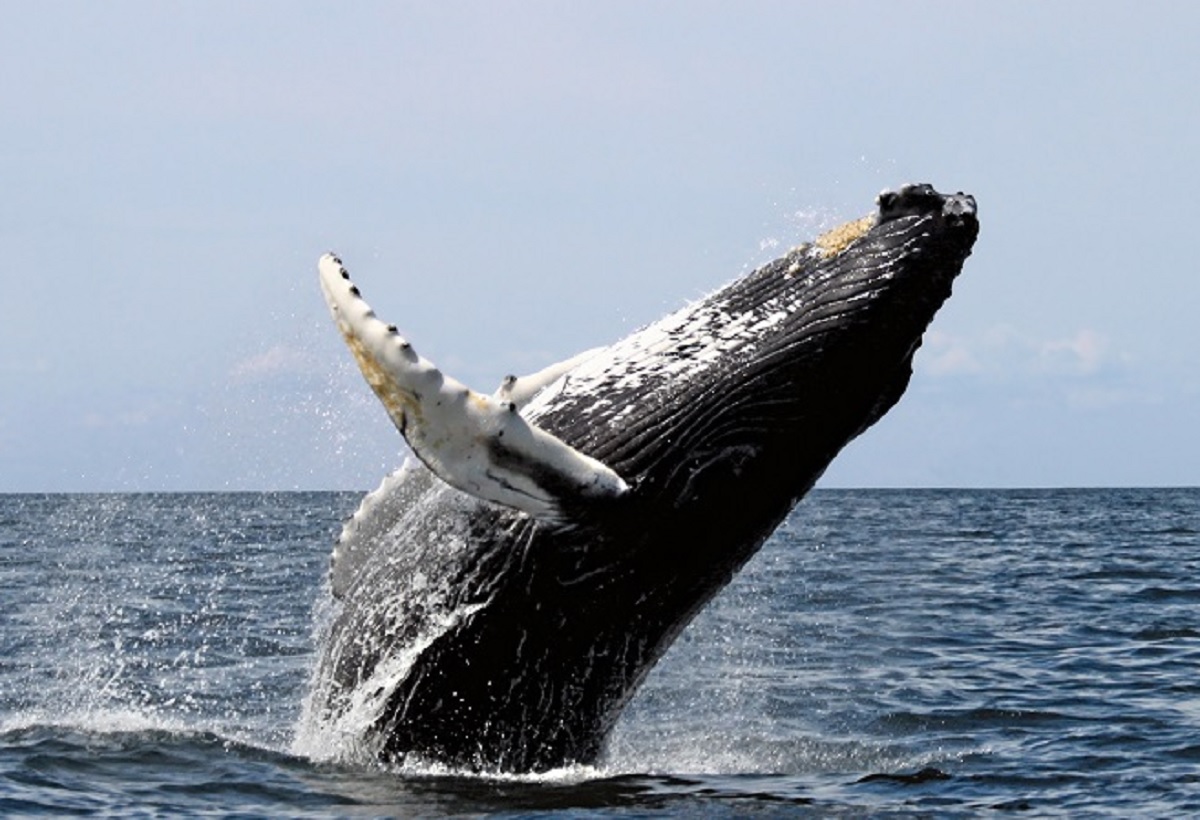
In 2019, researchers sailed to a sprawling seamount off the coast of South Africa, and lowered hydrophones to the seafloor. They picked up all kinds of noises: waves, the crackling of the reef, dolphin clicks and whistles, and an assortment of humpback whale calls. Mixed in with the humpback sounds were noises reminiscent of gunshots. Right whales are known to make gunshot sounds, but none were around at the time of recording. So were these mysterious sounds coming from humpbacks? This article is written by Elizabeth Claire Alberts, staff writer, Mongabay.
“We’ve never really heard about it being made by humpbacks or seen anything in the literature,” Erin Ross-Marsh, the researcher who first detected the calls and the lead author of a new paper about this finding, told Mongabay. “We’ve been studying humpback whale vocal communication since the early ’70s, and even after decades of study, we’re still discovering completely new and unexpected things.”
Humpback populations at Vema Seamount
The recordings were made during an expedition led by Greenpeace International and Sea Search Research and Conservation. One aim of the expedition was to learn more about two populations of humpback whale (Megaptera novaeangliae) that migrate through the Vema Seamount, a biodiversity hotspot about 1000 km from Cape Town.
It’s believed that humpbacks use Vema as a foraging ground as well as navigational beacon as they make their way toward Antarctica. At the same time, very little is known about humpback behavior in this part of the ocean, said Kirsten Thompson, study co-author and scientist at the University of Exeter, U.K., and Greenpeace International Research Laboratories.
“There’s a lot that we don’t know about what whales do offshore, how they behave, where they actually congregate for parts of their migration, and what parts of the ocean are important to them,” Thompson told Mongabay. “So it’s quite exciting.”
Humpback populations, Australia
While gunshot sounds have never been recorded in these populations of humpbacks, the authors of a 2017 study recorded a similar sound, which they characterised as a “bop,” in a different population of humpbacks off the coast of Brisbane, Australia. This helped strengthen the argument that the humpbacks at Vema were also making such sounds.
“Looking at the spectrographic analysis of that [sound], it seems very similar,” said Ross-Marsh, who is currently a Ph.D. candidate at Stellenbosch University in South Africa. “But it was a very minor portion of that paper.”
Right now, the researchers don’t know why humpback whales would make these gunshot sounds, but they theorize that they could have something to do with mating or feeding.
Why and how
“The next step is to understand why it’s used, where it’s used, how much it’s used, and that really requires further investigation with different methods,” study co-author Jack Fearey, a researcher at the University of Cape Town, told Mongabay.
“Maybe you can put acoustic tags on animals or follow them on a smaller ship and record them for a while while noting what their behaviors are.”
Humpback whales have made a remarkable recovery from the days when they were targeted by whaling vessels, but global whale populations are starting to struggle as food resources shift and deteriorate, the paper notes.
More protection for Vema Seamount
Shortly after the discovery of the Vema Seamount in the 1950s, the region became the target of intensive fishing, the authors state. In 2007, the South East Atlantic Fisheries Organisation closed down some fishing activity in the area to protect species like the Tristan rock lobster (Jasus tristani).
The region has also been classified as a “vulnerable marine ecosystem” according to United Nations Food and Agriculture Organization criteria. However, some fishing still takes place at the seamount, and the area has also accumulated abandoned fishing gear, according to Greenpeace. This has led experts to argue that the Vema Seamount requires additional layers of protection to safeguard the region for the species that depend on it.
Thompson said marine regions like the Vema Seamount could be protected if U.N. members adopt a high seas treaty that would aim to protect 30% of the high seas — that is, areas beyond national jurisdiction — by 2030. Negotiators met earlier this year to discuss the establishment of the treaty, but it had yet to be finalized.
“This paper really highlights how important some of these areas are for migratory species, and that we can’t just take small areas of the ocean on their own — we have to have much more of a global approach to marine protection,” Thompson said. “And we potentially have a mechanism to be able to do so through the new treaty.”
Citations:
Rekdahl, M., Tisch, C., Cerchio, S., & Rosenbaum, H. (2016). Common nonsong social calls of humpback whales (Megaptera novaeangliae) recorded off northern Angola, southern Africa. Marine Mammal Science, 33(1), 365-375. doi:10.1111/mms.12355
Ross-Marsh, E. C., Elwen, S. H., Fearey, J., Thompson, K. F., Maack, T., & Gridley, T. (2022). Detection of humpback whale (Megaptera novaeangliae) non-song vocalisations around the Vema Seamount, southeast Atlantic Ocean. JASA Express Letters, 2(4), 041201. doi:10.1121/10.0010072
Mongabay articles such as this one are licensed under a Creative Commons Attribution-NoDerivatives 4.0 International License.
Read more about: Whale Migrations: How New UN Treaty Aims to Protect Species on the High Seas and Explaining the Super Groups of Humpback Whales on the West Coast of South Africa