

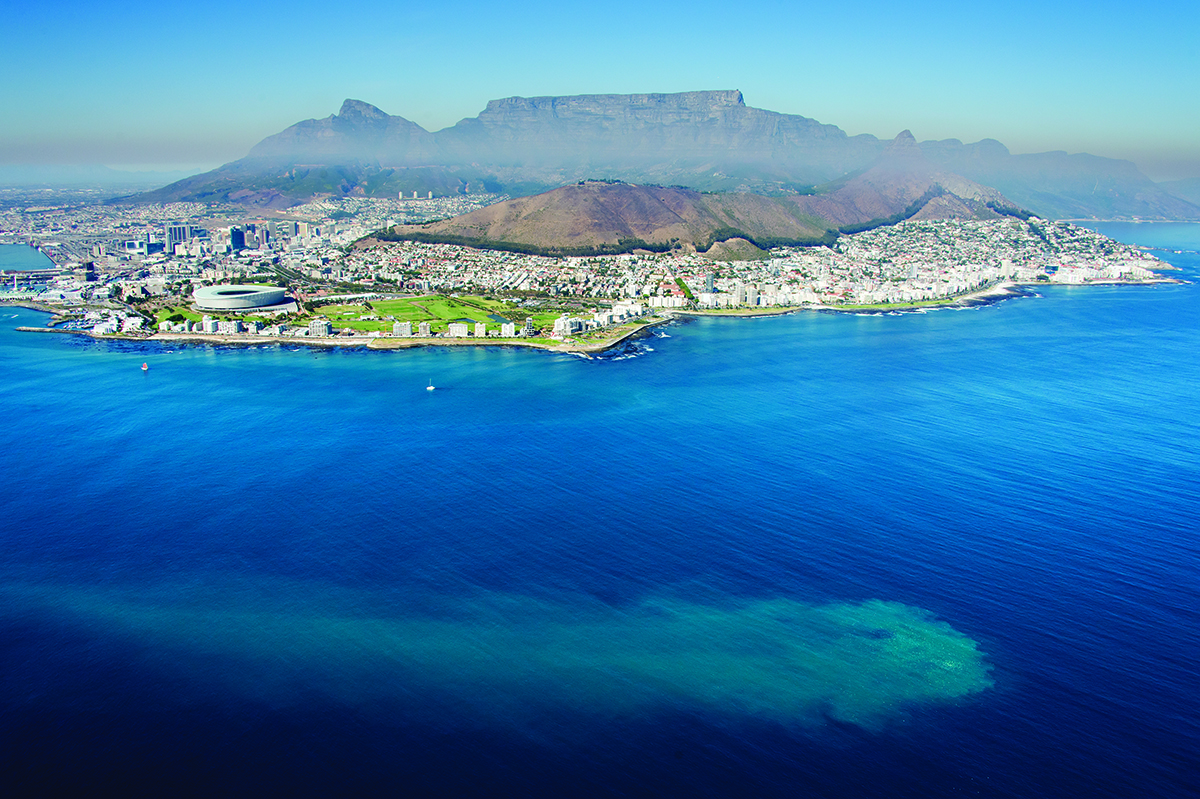
Outdoor photographer JEAN TRESFON has made a name for himself as Cape Town’s ‘eye-in-the-sky’, photographing everything from whales to sewerage plumes while flying his gyrocopter. Fishing Industry News Southern Africa spoke to him about his passion.
FINSA: How did you get into this?
JT: I have been diving and photographing underwater for over 26 years now, so my interest in the marine realm has long been established. Just under six years ago I asked a pilot friend to fly me along the De Hoop coastline so I could take some aerial photos for a project I was working on. After we landed he asked how the flight had been and I could tell that he was keen for me to share his excitement of having been in the skies.
Sadly I had been concentrating fully on getting the shots I required and hadn’t really paid much attention to the flying. He persisted and signed me up for an introductory flight with an instructor and I duly got a chance to fly the gyrocopter.
Again I was not immediately blown away by the experience, but somehow still ended up agreeing to do my pilot’s license. Halfway through the course the bug bit… hard! It was only natural to start taking my camera along once I felt comfortable enough with my flying, and of course I started photographing mainly marine subjects.
The public response to the images has been extremely gratifying and there is obviously a huge hunger for a different perspective of our wonderful city.
Ocean environment
FINSA: Clearly you have a great love for the ocean and the natural environment. Would you say your flying habit has allowed you a deeper appreciation / understanding of the ocean environment?
JT: Strangely enough I have learnt more about the ocean and its inhabitants during the last five years of flying than I did during all my years underwater.
Having flown now for several years I am starting to see the patterns in terms of wildlife behaviour. The arrival of the southern right whales in winter, the migrations of the humpback whales, the inshore movement of the great white sharks in the summer. It all start to make sense and then it’s possible to spot anomalies in the patterns.
A summer feeding aggregation of southern right whales in Table Bay? Tropical diamond squid on the surface during the day and in the shallow frigid waters of the West Coast? Every sighting adds to our database of knowledge.
I happily collaborate with many marine whale, shark and fisheries scientists and researchers. There is just so much about the ocean that we don’t know and every verifiable sighting adds tremendous value.
Animal behaviour
FINSA: How often do you interact with animals while flying? — ie birds / whales etc. Have you had any unusual encounters in this regard?
JT: With the possible exception of the small threat of a bird-strike, I never “interact” with animals while flying. My role is to observe rather than to interact.
I have seen animal behaviour from the air that I did not believe was possible. Fish ramming and chasing away a great white shark. Huge 2 metre long diamond squid swimming around on the surface in broad daylight. Thousands of hammerhead sharks spread across the surface in a vast shoal. Hundreds of humpbacks whales feeding together on pockets of krill. Thousands of common dolphins gathered in a superpod. Vast shoals of cape yellowtail spawning on the surface. Massive baitballs of sardines with only a few hungry cape fur seals in pursuit. Orcas attacking common dolphins. Great whites breaching and attacking seals right in the surf zone near popular beaches.
I have come to expect the unexpected!
Weather conditions
FINSA: What about unexpected bad weather while over the ocean? Have you had some unusual landings?
JT: Being a private pilot rather than a commercial pilot has some privileges. I get to choose when I fly and where. I never “have” to fly and most often tend to cherry pick the best weather for flying and photography.
Also my gyrocopter is an extremely capable machine and can fly in a wide range of wind and weather conditions. Having said all of that the weather can change rapidly and does not always bother to follow the forecast!
So no unusual landings and only one unplanned landing when I arrived back at my airfield to find it completely fogged in and had to divert to a nearby airfield, land and catch a taxi ride home.
Distance
FINSA: How far out do you venture?
JT: The short answer is not very far! Most often I stay strictly within gliding distance of land. Flying a small single-engine aircraft far out to sea is not a great idea.
Human activity
FINSA: As somebody who spends a lot of time patrolling the coast, have you noticed any obvious trends over the years, such as an increase/ decrease in vessels?
JT: As mentioned earlier, I am starting to see the patterns in terms of wildlife behaviour. In terms of human activity I have not really noticed obvious trends.
There are some remarkable one-off events such as photographing over 100 boats fishing in the Paulsberg Sanctuary Zone near Cape Point where fishing is completely banned. Every year there seem to be more vessels setting traps for rock lobster along the Atlantic coastline. But this is my own perception and cannot be accurately measured.
Marine life changes
FINSA: What about marine life? Have you observed an increase / decrease? Are there areas of marked abundance versus areas with markedly less activity?
JT: Some years have been much busier than others in terms of marine activity but no marked increase or decrease over a sustained period of time. The amazing thing is that there does not seem to be one area that is busier than others. The wildlife sightings vary in area on a day-to-day basis with events all along our coast.
Certain areas are known for certain animals. For example, the abundance of great whites along the inshore areas of False Bay during the summer months. And the huge gathering of Southern Right whales off Hermanus in the winter months. The baitfish shoals seem to pop up anywhere and everywhere depending on the winds, tides and currents.
Pollution
FINSA: What about pollution? Your pictures of sewerage plumes made national headlines? Has this been a consistent concern?
JT: One of the first things I noticed when I started flying around the Cape Peninsula was the huge sewerage plumes from the various outfalls. I had previously dived near all of the outfalls so the locations were well known to me. Over the years the plumes definitely appeared to get worse so I started a campaign to highlight the problem.
FINSA: Can you recall the first time you noticed these plumes? Were you mystified, or as a diver did you suspect straight away that they might be bad news?
JT: As mentioned above I knew exactly what they were!
City of Cape Town denial
FINSA: The City of Cape Town appeared to go into damage-control mode and initially appeared to deny these were sewerage plumes. Has there since been any acknowledgement or clarity? There was talk of some kind of report?
JT: Initially they flatly denied the plumes were from the outfalls, even going so far as to blame the plumes on passing ships, despite the fact they occurred regularly and in the exact charted positions of their own outfalls.
They also said that because the plumes in my images were white in colour it could not be sewage, which is brown. (For a start the effluent includes shower and drain water with detergents etc. which have an effect on the colour of the discharge and of course the diffusers on the end of their pipelines break up and aerates the plumes, also affecting the colour).
Subsequently they have changed their tune to admitting that the plumes are their doing but are now saying there is no alternative to dumping untreated human waste into the ocean, which of course is complete nonsense. It all comes down to money! The issue has gone quiet for now.
The City applied for a permit and there was a public participation process but none of the people who commented or objected have received any feedback after nearly a year. I understand the City commissioned the CSIR to do some testing but other than that nothing appears to have been done.
FINSA: An apology would have been nice?
JT: Hahaha…! Really? I think there is more chance of me hitting the proverbial flying pig while out flying!
Foreign fishing vessels
FINSA: What about foreign fishing vessels — another topic du jour. Do you observe a lot of trawler activity? I guess it isn’t possible to tell what is legal or illegal?
JT: Trawler activity usually takes place far offshore and as you quite correctly point out it’s impossible to tell legal from illegal from the air.
However the line fishery is a different story and as mentioned earlier I have spotted illegal fishing on several occasions.
Abalone poaching is also easy to spot from the air. Then again these days the poachers are so brazen they conduct their activities in broad daylight in full view of the public, secure in the knowledge that enforcement of the rules is highly unlikely.
Aerial monitoring programme
FINSA: Not long ago the SAAF canned its aerial monitoring programme which used to guard against illegal fishing. Would you say this was a bad decision?
JT: I was not aware of this. Presumably it was a decision based on budgetary constraints. In any case monitoring is only an effective tool when coupled with an effective task force to ensure enforcement of the regulations.
FINSA: How about taking on the (aerial) job?
JT: No thanks! I am purely a recreational pilot! I do fly more regularly than most recreational pilots and will always report any illegal behaviour observed in and around the oceans, but for now this is a hobby rather than a profession.
Favourite memories
FINSA: What is your all-time favourite flight?
JT: When I started flying my instructor told me, “You are privileged to be able to fly, and doubly privileged to be able to fly in Cape Town!”
Every flight in the Mother City is special, but my favourite has to be flying the Peninsula and especially rounding Cape Point, such a spectacular and iconic landmark that so few get to observe from the aerial vantage point.
FINSA: What is your all-time favourite photograph?
JT: Again, such a tough call. Of my own images taken while flying, the image of nearly 100 humpback whales gathered in a tight feeding aggregation comes to mind.
FINSA: If you were forced to retire to one spot along the South African coastline, where would it be?
JT: More than likely the little hamlet of Infanta, on the west bank of the Breede River mouth.
Marine Protected Areas
FINSA: Do you have any particular views on Marine Protected areas / seabed mining and SA’s commercial fishing industry? Is enough being done to protect SA’s maritime heritage?
JT: I could fill several pages with my views on these topics. Let’s just say that I am a huge fan of properly functioning MPA’s.
Unfortunately there are far too many “paper parks” that are protected in name alone. The Table Mountain MPA is a good example. Most of this supposed MPA is still open to fishing.
The few sanctuary zones are not policed and as mentioned I have photographed over 100 vessels fishing in the sanctuary zone with the SANParks/DAFF officials present. Other than checking fishing permits there was no mention made of the fact that fishing was not allowed in the area.
In an email response from SANPArks they admitted that their rangers were not trained in the use of a GPS and thus could not establish the boundaries of the Sanctuary Zone, despite the fact that I could tell at a glance from air that the boats were inside the zone.
So if there is no enforcement what is the point of the MPA?
The De Hoop MPA is a good example of a properly functioning MPA where there is a complete No-Take policy and fishing is completely forbidden. This allows it to act as a breeding ground to repopulate the surrounding areas with fish.
Seabed mining
I cannot comment on seabed mining as I know very little about the topic, and commercial fishing is a very broad topic spanning pelagics, the line fishery, demersal long-lining, rock lobster etc.
The little I have personally seen of the commercial fishing industry (including spending a night aboard a purse-seiner 100km offshore to document the fishing), is that it is more regulated and better managed than the recreational fishermen would like to presume. Again this is not my area of expertise.
Equipment used
FINSA: Tell us a little about your equipment. Is your camera mounted on the wing and then activated automatically? Do you click and drive?
JT: My aircraft is a gyrocopter, a two-seater open cockpit fuselage with a pusher propeller at the back and a rotor blade overhead. My wing (the rotor) turns at nearly 700kph so not really ideal for a camera mount!
Jokes aside I use a handheld Nikon D4 SLR. The gyrocopter is a very stable and forgiving aircraft, so depending on the weather I can either let go of the joystick and shoot with both hands or if the air is a little turbulent then I fly with my left hand and shoot with my right.
Flying and photographing at the same time can get rather challenging and obviously the flying takes priority so I have missed many amazing photo opportunities, but at least I’m still around to try again!
Conclusion
FINSA: You’re a Capetonian, born and bred? Was this a factor in your love of the Great Outdoors?
JT: Definitely! This is an amazing place to live, with both the mountains and the sea so accessible to all. You don’t need to be able to fly to get amazing aerial views, just pull on your hiking boots and hit the trail!





Comments are closed.